

How much does a website cost for a small business? The honest answer is “it depends,” but that is not very useful when you are trying to set a budget. This guide breaks the cost into the pieces you actually pay for: the build, the monthly running costs, and the ongoing maintenance. By the end you should know which route fits your business and what a fair quote looks like.

The Short Answer
There are three common ways to get a small business website, and each has a very different price tag:
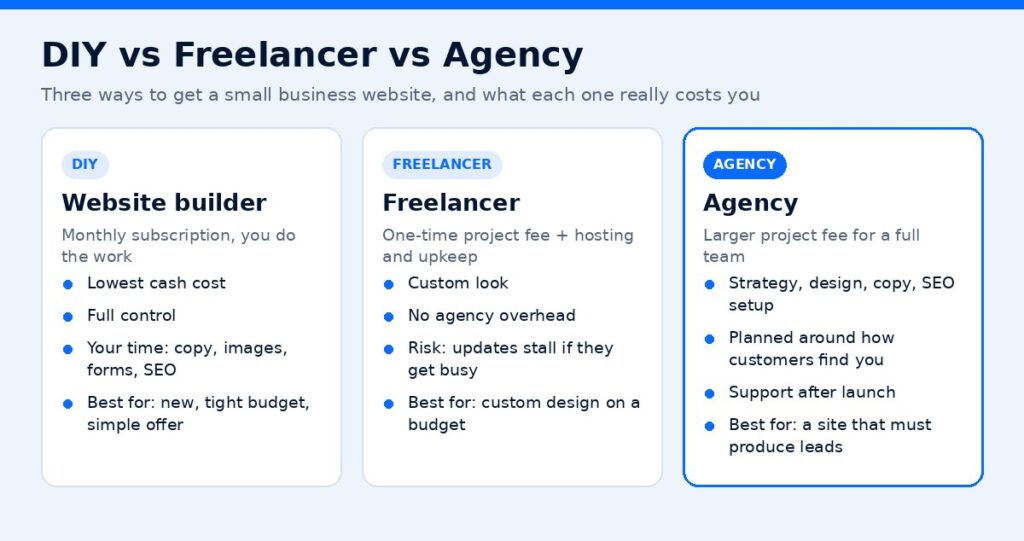
- DIY website builder: you pay a monthly subscription and do the work yourself.
- Freelancer: you pay a one-time project fee, plus hosting and upkeep.
- Agency: you pay a larger project fee for strategy, design, copy, SEO setup, and support.
Published estimates vary a lot. Elementor’s 2026 guide, for example, puts a freelancer-built WordPress site at roughly $2,000 to $8,000 and an agency-built small business site at roughly $10,000 to $35,000 (source). Many local businesses end up somewhere in between, because the real driver is scope, not the word “agency.”
How Much Does a Website Cost per Month?
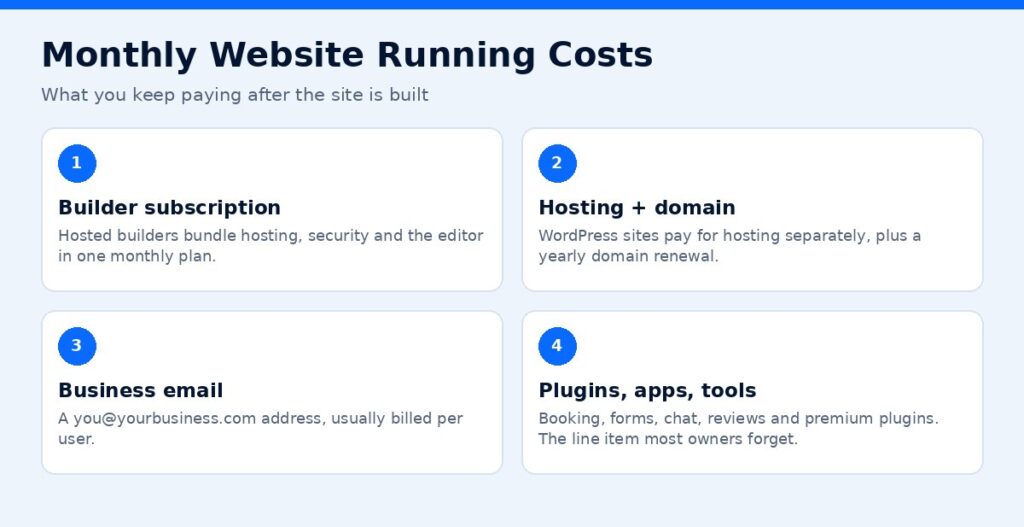
Even after the site is built, you will pay some recurring costs. Here is what to expect on the monthly side.
Website builder subscription
If you use a hosted builder, the subscription covers hosting, security, and the editor. As an example, Squarespace’s pricing page (checked November 1, 2026) lists its Basic plan at $25 per month billed monthly or $19 per month billed annually, and its Core plan at $39 per month or $29 per month billed annually (Squarespace pricing). Builder prices change often, so always check the current pricing page.
Hosting and domain
If your site runs on WordPress, you pay for hosting separately. Shared hosting is the cheapest option, while managed WordPress hosting costs more but handles speed, backups, and updates for you. You will also renew your domain name every year. Some builders include a free domain for the first year on annual plans, then charge a renewal.
Business email
A professional address like you@yourbusiness.com usually comes from Google Workspace or Microsoft 365 and is billed per user. It is a small cost, but it adds up if your team grows.
Plugins, apps, and tools
Booking tools, forms, live chat, review widgets, and premium plugins often carry their own monthly or yearly fees. This is the line item most owners forget.
What Drives Website Design Cost?
When two quotes for “a five-page website” differ by thousands of dollars, it is usually because they include different work. These are the factors that move the price most:
| Cost driver | Lower cost | Higher cost |
|---|---|---|
| Design | Pre-built template | Custom design for your brand |
| Pages | 5 to 7 core pages | Location pages, service pages, blog |
| Copywriting | You supply the text | Professional copy written for search and sales |
| SEO setup | Basic titles and descriptions | Keyword research, schema, local SEO setup |
| Features | Contact form | Booking, payments, member areas, integrations |
| Ecommerce | None | Product catalog, checkout, shipping rules |
| Support | Handover only | Ongoing updates, backups, and reporting |
A good quote lists each of these clearly. If a proposal only says “website: $X,” ask for a breakdown before you sign.
DIY vs Freelancer vs Agency
DIY website builder
Best for: brand-new businesses with a tight budget and a simple offer.
The upside is low cost and full control. The downside is your time. Most owners underestimate how long it takes to write good copy, pick images, set up forms, and get the basic SEO right. A DIY site can work well as a starting point, as long as you treat it as version one.
If you mainly need a landing page, an email list, and a simple funnel, an all-in-one platform like Systeme.io can be a budget option. Its pricing page (checked November 1, 2026) lists a free plan with up to 2,000 contacts and paid plans starting at $17 per month (Systeme.io pricing).
Freelancer
Best for: businesses that want a custom look without agency overhead.
A skilled freelancer can deliver a great site. The risk is continuity: if your freelancer gets busy or moves on, updates can stall. Ask who will handle security updates, backups, and fixes after launch.
Agency
Best for: businesses that need the website to produce leads, not just look good.
An agency typically brings a team: strategy, design, development, copywriting, and SEO. You pay more, but you should also get a site planned around how customers find you and how they contact you. The key question to ask any agency is how they will measure success after launch.
How Much Does It Cost to Maintain a Website for a Small Business?
Maintenance is the cost that keeps your site secure, fast, and accurate. It usually covers:
- Software, theme, and plugin updates
- Regular backups and a tested restore process
- Security monitoring and malware cleanup
- Uptime and speed checks
- Small content edits (new staff, prices, hours, photos)
- Broken link and form checks
Elementor’s guide estimates ongoing maintenance at about $50+ per month for a freelancer and $150+ per month for an agency (source). Whatever you pay, get the scope in writing. “Maintenance” means very different things to different providers.
Hidden Website Costs to Budget For
These are the surprises that turn a fair quote into a frustrating one:
- Content: professional photos, stock images, and copywriting
- Premium plugins or apps: often billed yearly
- Third-party tools: booking, chat, CRM, email marketing
- Domain and email renewals: introductory prices often go up after year one
- Revisions: extra rounds of changes beyond what the quote includes
- Accessibility and legal pages: privacy policy, cookie banner, terms
A simple rule: keep a buffer in your budget for extras you discover during the project.
How to Get an Accurate Website Quote
Before you contact anyone, write down answers to these questions. They make quotes faster and easier to compare.
- What is the main job of the site? (Calls, bookings, quote requests, online sales)
- Who is your ideal customer and what do they search for?
- How many pages do you need, and which services need their own page?
- Do you have a logo, brand colors, photos, and copy ready?
- Which tools must connect to the site? (CRM, booking, payments, email)
- Who will update the site after launch?
- What is your launch date and your budget range?
Then ask every provider the same follow-up questions: Who owns the site and the domain? What happens if we stop working together? What is included in the price, and what costs extra?
Is a Cheap Website a Good Deal?
Sometimes. A low-cost site is fine when your business mainly runs on referrals and the website is a digital business card. It becomes expensive when you rely on the site for new customers but it loads slowly, ranks nowhere, and makes it hard to call or book.
Think about value, not just price. A website that brings in a steady flow of qualified enquiries can pay for itself, while a cheap site that brings in nothing costs you every month in missed opportunities.
How ScaleMyClick Approaches Website Projects
At ScaleMyClick, websites are built around one goal: turning visitors into leads. That means fast pages, clear calls to action, service pages written for search, and tracking so you can see what works. Learn more about our website design and development service, or see how we pair new sites with search engine optimization so the right people actually find them.
Get a Free Marketing Audit
Not sure whether your current website is helping or hurting? ScaleMyClick offers a free marketing audit for small businesses. You get a plain-English look at your site, your search visibility, and where leads are slipping away, plus a short list of fixes in priority order.
Related guides
- How Much Do Digital Marketing Agencies Charge Per Month?
- HighLevel Pricing 2026: Plans, Usage Costs and Which One to Pick
- How Much Does SEO Cost for a Small Business in 2026?
FAQs
How much does a basic small business website cost?
A basic site built on a website builder can start with just the monthly subscription if you do the work yourself. A professionally built site costs more because you pay for design, copy, and setup. Get two or three itemized quotes to see what is normal in your area.
How much does a website cost per month?
Monthly costs usually include hosting or a builder subscription, your domain (billed yearly), business email, and any paid plugins or apps. Maintenance plans are extra if you want someone else to handle updates and backups.
Is WordPress cheaper than Squarespace or Wix?
WordPress software is free, but you still pay for hosting, a domain, and often premium themes or plugins. Hosted builders bundle these into one subscription. WordPress gives you more flexibility; builders give you simplicity.
How long does it take to build a small business website?
A simple site can go live in a few weeks if content is ready. Larger projects with custom design, many pages, or integrations take longer. Delays usually come from missing content, so have your copy and photos ready early.
Should I redesign my website or start over?
If the site is slow, hard to update, and not bringing leads, a rebuild is often more cost-effective than patching it. If the structure is solid, a focused update to speed, copy, and calls to action may be enough.
Sources
- Elementor: How Much Does a Small Business Website Cost?
- Squarespace pricing (checked November 1, 2026)
- Systeme.io pricing (checked November 1, 2026)