


If you have ever asked an agency “how much does SEO cost for a small business?”, you probably got the classic answer: “it depends.” That answer is true, but it is not helpful. This guide gives you real price ranges from published survey data, explains what you are actually paying for, and shows you how to work out whether SEO is worth it for your business before you sign anything.
Short version: most small businesses pay a monthly retainer, local SEO usually costs less than national SEO, and the cheapest offer is rarely the best value. Here is how to think about it.
How Much Does SEO Cost for a Small Business? The Quick Answer
The most useful public data set on SEO pricing is a survey of 439 SEO providers published by Ahrefs. According to Ahrefs’ SEO pricing study (last updated August 2024):
- SEO usually costs between $250 and $10,000 per month, and 63% of businesses spend between $500 and $5,000.
- Local SEO averages about $1,557 per month, and the study suggests small business SEO lands in a similar range.
- Agencies charged an average of $3,209 per month, compared with $1,348 for freelancers.
- 78.2% of providers charge a monthly retainer, which is the most common pricing model.
Treat these as reference points, not a price list. The survey is from 2024 and prices vary by city, industry and competition. Still, they give you a realistic frame: if someone offers “page one of Google” for $99 a month, the math does not work, and if someone quotes $15,000 a month for a single-location bakery, ask what you are paying for.
How Much Does SEO Cost Per Month? Pricing Models Explained
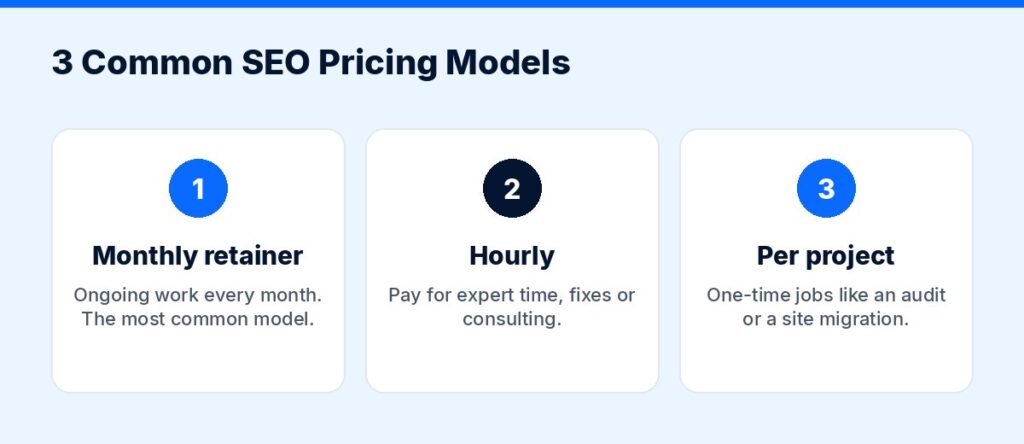
SEO is sold in three main ways. Knowing them helps you compare quotes that look completely different on paper.
| Pricing model | How it works | Best for |
|---|---|---|
| Monthly retainer | A fixed monthly fee for ongoing work: content, technical fixes, links, local SEO, reporting | Most small businesses that want steady growth |
| Hourly | You pay for time, often for consulting or specific fixes | Businesses with an in-house person who needs expert guidance |
| Per project | A one-time fee for a defined job, such as an SEO audit, a site migration or a local SEO setup | A clean starting point or a one-off problem |
A retainer makes sense for most small businesses because SEO compounds over time. Rankings come from many small improvements made consistently, not from a single burst of work. A one-time project, like an audit or a Google Business Profile cleanup, is a smart first step if you want to test a provider before committing.
What Actually Drives the Cost of SEO?

Two businesses can get very different quotes for “SEO.” These are the factors that move the price.
1. Local vs. national competition
A plumber who wants to rank in one city is competing with a few dozen local businesses. An online store that wants to rank nationwide is competing with big brands and marketplaces. Local SEO is usually cheaper because the playing field is smaller, which matches the Ahrefs data above.
2. The state of your website
If your site is slow, hard to use on a phone, missing basic pages for each service, or built on a template that search engines struggle to read, some of the budget has to go into fixing the foundation first. Sometimes the most cost-effective SEO move is a better website. Our website design and development team often handles that part alongside SEO.
3. How much content you need
Ranking for “emergency plumber in Tampa” might need one excellent service page. Ranking for dozens of services across several towns needs many pages, plus blog content that answers common questions. Content is usually the biggest line item in an SEO budget.
4. Links and local citations
Search engines still look at who mentions and links to your business. Earning those mentions (local directories, partners, press, community sites) takes time and outreach, which costs money.
5. Reporting and strategy
Good SEO includes regular reporting that ties rankings and traffic to calls, form fills and sales. Cheap packages often skip this, which makes it impossible to know if the money is working.
What You Get at Different Budget Levels
These tiers are general guidance on what a sensible scope looks like, not quotes:
- Starter budget (lower end of the local range): Google Business Profile optimization, fixing key technical issues, improving your main service pages, basic citation cleanup and a simple monthly report.
- Growth budget (middle of the range): everything above plus new service and location pages, regular blog content, review generation support and ongoing link building.
- Competitive budget (upper range): larger content programs, digital PR, advanced technical SEO, and SEO that is coordinated with paid ads and conversion rate improvements.
If a quote does not tell you which of these activities you are getting each month, ask for a written scope.
Is SEO Worth It for a Small Business?
SEO is worth it when the value of the customers it brings in is higher than what you pay, over a realistic time frame. Here is a simple way to estimate that before you spend anything:
- Write down the average value of a new customer (first purchase, or lifetime value if customers come back).
- Estimate your close rate: out of 10 people who call or fill in a form, how many become customers?
- Divide your proposed monthly SEO budget by the customer value. That is how many new customers per month SEO needs to bring in to break even.
- Ask the provider whether that number is realistic for your market, and over what time frame.
Example with round numbers: if a new customer is worth $2,000 to you and SEO costs $1,500 a month, you need roughly one extra customer a month to cover the cost. For many service businesses, that is a reasonable target once SEO has had time to work. If each customer is worth $50, SEO needs to bring in 30 customers a month for the same budget, so you would want a leaner plan or a different channel first.
SEO is a long-term channel. If you need leads this week, paid ads usually come first. Read our guide on SEO vs Google Ads to decide which to start with.
Red Flags When Comparing SEO Quotes
- Guaranteed rankings. Nobody controls Google’s results. A guarantee usually means they will rank you for terms nobody searches.
- No access to your own accounts. You should own your website, Google Business Profile, Google Analytics and Search Console.
- Vague deliverables. “Ongoing optimization” with no list of tasks is impossible to measure.
- Long lock-in contracts with no exit. A reasonable provider will agree to clear terms and a notice period.
- Reports full of vanity metrics. Rankings for terms that bring no customers do not pay your bills. Ask how they track calls and leads.
Can You Do Some SEO Yourself?
Yes, and it can lower what you pay an agency. Small business owners can usually handle these without help:
- Keep your Google Business Profile complete and up to date, with real photos and accurate hours.
- Ask every happy customer for a Google review (see our guide on how to get more Google reviews).
- Make sure each service you offer has its own page with clear details and a way to contact you.
- Answer common customer questions in short blog posts.
If you want to research keywords and track rankings yourself, an SEO tool like Semrush can show you what your competitors rank for and which keywords are worth targeting. Check the current plans and pricing on Semrush’s site before you sign up.
Affiliate link — we may earn a commission.
For a structured DIY plan, use our local SEO checklist for small businesses.
How to Get the Most From Your SEO Budget
- Start with an audit. Know what is broken before you pay to fix it.
- Focus on money pages first. Service pages and your Google Business Profile usually bring leads faster than blog posts.
- Track leads, not just traffic. Set up call tracking and form tracking from day one.
- Give it time, but ask for milestones. Agree on what should improve in 3, 6 and 12 months.
- Combine channels wisely. SEO plus a small, well-run ads campaign often beats either one alone.
If you would rather hand it off, our SEO services cover local SEO, on-page work, content and reporting for small businesses.
Get Your Free Marketing Audit
Not sure where your next customers should come from? ScaleMyClick’s free marketing audit looks at your SEO, ads, website conversion and automation and points out 3 specific opportunities that could be limiting your growth. No pressure, no long contract talk, just a clear next step.
Related guides
- How Much Do Digital Marketing Agencies Charge Per Month?
- White Label SEO: What It Is, How It Works, Pros and Cons
- SEO vs Google Ads: Which Should a Small Business Do First?
- Marketing Tools & Resources (our recommended tools)
FAQ: SEO Costs for Small Businesses
How much does SEO cost per month for a small business?
Published survey data from Ahrefs puts the average for local SEO at about $1,557 per month, with most businesses spending between $500 and $5,000 per month on SEO overall. Your price depends on competition, your website’s condition and how much content you need.
Why do SEO prices vary so much?
Because the work varies. A single-location business in a quiet market needs far less work than a multi-location brand in a crowded industry. Agency vs. freelancer, experience level and location also affect price.
How long does SEO take to work?
SEO builds over months, not days. Quick wins like fixing a Google Business Profile can help sooner, but meaningful growth in organic leads usually takes consistent work over several months. Be wary of anyone promising fast, guaranteed results.
Is cheap SEO worth it?
Very cheap packages often mean automated reports, low-quality links or no real work. That can waste money or even hurt your site. It is better to pay for a smaller, clearly defined scope done well.
Should I do SEO or Google Ads first?
If you need leads right away, ads are faster. If you want a lower cost per lead over time, SEO pays off. Many small businesses run a small ads campaign while SEO builds. Our SEO vs Google Ads guide walks through the decision.
This contains an affiliate link.