
An AI answering service for small business promises something every owner wants: no more missed calls. Instead of a phone ringing out while you are on a job, with a customer, or closed for the night, an AI voice agent picks up, answers common questions, and books the appointment or takes a message.
But is it worth it for your business? This guide explains how AI receptionists work, where they shine, where they fall short, and how to decide.

What Is an AI Answering Service?
An AI answering service is software that answers your business phone calls using a conversational AI voice. It listens to what the caller says, responds in natural language, and takes an action, such as:
- Answering questions about hours, location, services, and pricing ranges
- Booking, rescheduling, or canceling appointments on your calendar
- Collecting caller details and the reason for the call
- Sending a text with a booking link or follow-up information
- Transferring urgent calls to a person
- Logging the call and a summary in your CRM
It is different from a traditional answering service, where a human operator takes messages, and from a basic phone menu (“press 1 for sales”), which cannot hold a conversation.
AI Receptionist vs Virtual Receptionist vs Voicemail
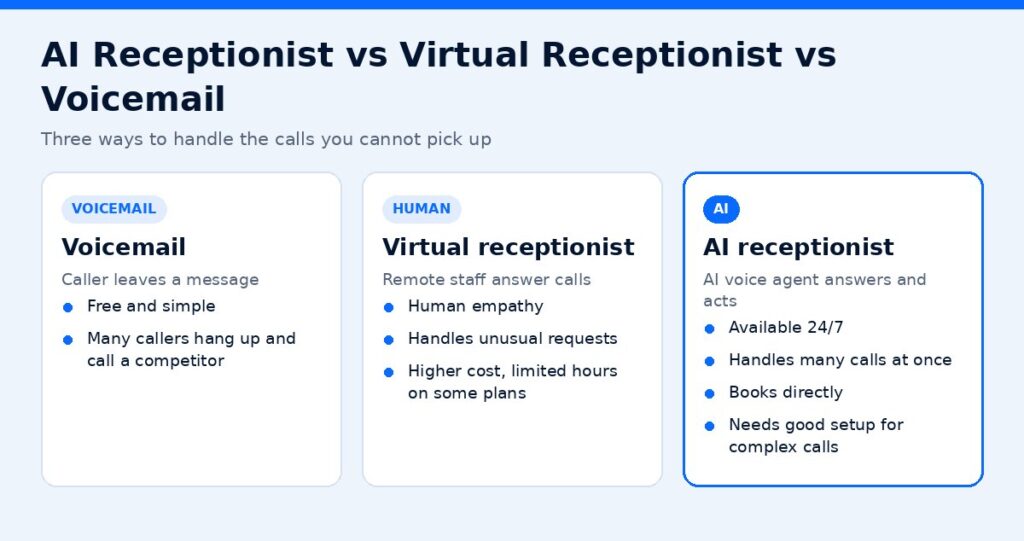
| Option | How it works | Strengths | Limits |
|---|---|---|---|
| Voicemail | Caller leaves a message | Free, simple | Many callers hang up and call a competitor |
| Virtual receptionist (human) | Remote staff answer calls | Human empathy, handles unusual requests | Higher cost, limited hours on some plans |
| AI receptionist | AI voice agent answers and acts | Available 24/7, handles many calls at once, books directly | Needs good setup, can struggle with complex or emotional calls |
Many businesses end up with a hybrid: the AI handles routine calls and after-hours enquiries, and anything sensitive goes to a person.
Where an AI Phone Answering Service Works Well
AI receptionists are strongest when calls are frequent, repetitive, and lead to a clear outcome. Good fits include:
- Home services: plumbers, HVAC, roofers, electricians, cleaners. Calls often come in while the team is on site.
- Appointment-based businesses: salons, dental and chiropractic offices, med spas, auto repair.
- Professional services: law firms and accountants that need to qualify new enquiries before a consultation.
- Restaurants and local retail: hours, directions, reservations, and order status questions.
If a large share of your calls are the same handful of questions, an AI agent can handle them consistently and free up your team.
Where It Can Fall Short
AI is not the right answer for every call. Watch out for:
- Complex or emotional conversations: complaints, medical concerns, or legal situations usually need a human.
- Poor setup: an AI agent is only as good as the information and rules you give it. Vague instructions lead to vague answers.
- Bad hand-offs: if callers cannot reach a person when they need one, frustration grows quickly.
- Accuracy risks: the agent should never guess at prices, availability, or policies. Give it clear facts and tell it when to say “let me have someone call you back.”
- Compliance: if you work in a regulated industry, check how call recordings and data are stored, and follow the call-recording and consent rules that apply in your state.
Is an AI Answering Service Worth It? How to Decide
Ask yourself these five questions:
- How many calls do you miss? Check your phone records for unanswered calls, especially after hours and at lunch.
- What is a new customer worth to you? If one booked job covers the monthly cost, the math is easy.
- Are most calls predictable? If yes, AI handles them well.
- Can it connect to your calendar and CRM? Without integration, you still have manual work.
- Who reviews the calls? Someone should read call summaries weekly and improve the script.
If you miss calls regularly, most calls are routine, and new customers are valuable, an AI receptionist is usually worth testing.
What It Costs: What to Check
Pricing models vary by provider, so check current pricing on each vendor’s site. Common models include:
- A flat monthly fee with a set number of minutes or calls
- Per-minute or per-call usage pricing
- Platform fees plus phone number and telephony charges
- Setup fees for custom scripts and integrations
When comparing, look at the total monthly cost at your real call volume, not just the starting price. Also check contract length, overage charges, and whether call recordings and transcripts are included.
How to Set Up an AI Receptionist for Your Small Business
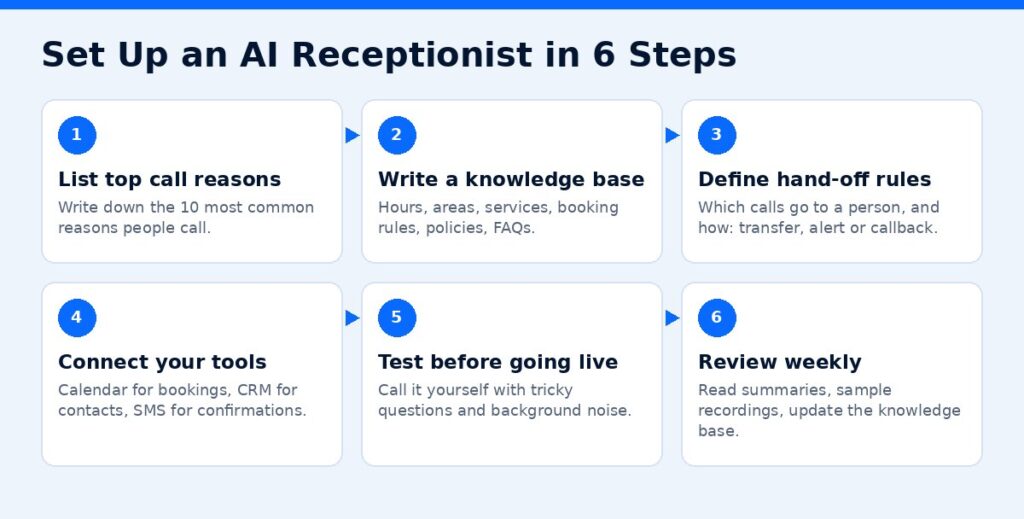
Step 1: List your top call reasons
Go through recent calls and write down the 10 most common reasons people call. These become the core of your AI agent’s knowledge.
Step 2: Write a clear knowledge base
Include hours, service areas, services offered, what affects price, booking rules, cancellation policy, and frequently asked questions. Keep it factual and current.
Step 3: Define hand-off rules
Decide which calls must go to a person (emergencies, complaints, existing clients with problems) and how: live transfer, urgent text alert, or a callback promise with a time frame.
Step 4: Connect your tools
Link the agent to your calendar for bookings, your CRM to log contacts, and SMS to send confirmations. Platforms like GoHighLevel include voice AI features alongside CRM, calendars, and texting in one place, which can simplify this step.
Affiliate link — we may earn a commission.
Step 5: Test before going live
Call the number yourself and ask the agent tricky questions. Try different accents, background noise, and unusual requests. Fix anything it gets wrong before customers hear it.
Step 6: Review and improve weekly
Read call summaries, listen to a sample of recordings, and update the knowledge base. The first month of tuning makes the biggest difference.
Questions to Ask Any AI Answering Service Provider
Before you sign up, ask each provider:
- Can I hear sample calls or test the agent with my own information first?
- How does it hand off to a person, and how fast?
- Which calendars, CRMs, and phone systems does it integrate with?
- Can I keep my existing business phone number?
- Who owns the call recordings, transcripts, and contact data?
- What happens when the AI does not know an answer?
- What is the total cost at my expected call volume, including overages?
- Is there a contract, and how do I cancel?
A Simple Script Structure That Works
Most effective AI receptionist scripts follow the same flow:
- Greeting: business name, a friendly welcome, and a note that the caller is speaking with a virtual assistant.
- Intent: “How can I help you today?” The agent identifies whether it is a new booking, a question, or an urgent issue.
- Answer or action: it answers from your knowledge base or books the appointment.
- Details: it confirms the caller’s name, number, and reason for calling.
- Next step: it confirms what happens next, such as a text confirmation or a callback within a set time.
Keep each answer short. Callers want quick, clear replies, not long speeches.
Pair It With Missed Call Text Back
An AI receptionist answers calls, but some callers will still hang up or call when lines are busy. A missed call text back automation sends an immediate text so the conversation continues by SMS. Together, they close most of the gaps where leads slip away.
How ScaleMyClick Can Help
ScaleMyClick sets up AI phone agents, booking flows, and CRM automations for small businesses, including the scripts, hand-off rules, and testing that make them sound professional. See our AI automation solutions, or explore how we connect them to your website and lead forms.
Get a Free Marketing Audit
Not sure whether your current website is helping or hurting? ScaleMyClick offers a free marketing audit for small businesses. You get a plain-English look at your site, your search visibility, and where leads are slipping away, plus a short list of fixes in priority order.
This contains an affiliate link.
Related guides
- How to Create a Voice AI Agent in GoHighLevel
- AI Chatbot for Your Website: A Small Business Guide
- 15 AI Automation Examples for Small Businesses
- Marketing Tools & Resources (our recommended tools)
FAQs
Can an AI answering service replace a receptionist?
It can handle many routine calls, such as questions, bookings, and message taking, at any hour. Most businesses still keep a person available for complex, sensitive, or high-value conversations.
Do callers know they are talking to AI?
Modern AI voices sound natural, but being upfront builds trust. Many businesses have the agent introduce itself as a virtual assistant and offer a way to reach a person.
Can an AI receptionist book appointments?
Yes, if it is connected to your calendar. It can check availability, book a slot, and send a confirmation by text or email.
Is an AI answering service secure?
It depends on the provider. Check where recordings and transcripts are stored, who can access them, and whether the provider meets any compliance requirements for your industry.
How long does setup take?
A basic agent with FAQs and call forwarding can be set up fairly quickly. Calendar and CRM integrations, custom scripts, and testing take longer, so plan for a short testing period before launch.