
If you run a plumbing company, a law firm, a cleaning service or a dental practice, you have probably seen the ads with a “Google Verified” badge at the very top of search results, and maybe a sales rep has called you about them. So, are Google Local Services Ads worth it? For many local service businesses, yes, but only if you can answer leads fast, keep strong reviews, and manage lead quality. This guide explains how they work, what you pay for, and how to decide.
What Are Local Services Ads?
Local Services Ads (LSAs) are a Google ad format built for local service providers. Instead of paying for clicks, you pay for leads: calls, messages and, in some cases, booking requests from potential customers. Google’s own product page for Local Services Ads sums it up as “you only pay for customers, not clicks,” with prominent placement in local search and a Google Verified badge on your profile.
LSAs are available for specific categories. Google’s page lists examples across home services (plumbers, electricians, HVAC, roofers, cleaners and many more), business services (such as lawyers, accountants and real estate), health (such as dentists and optometrists), and other groups like education, care, wellness, beauty and automotive. Availability depends on your category and location.
How Local Services Ads Work
- You pass Google’s screening. According to Google’s screening and verification guide, the checks vary by category and location and may include background, business registration, insurance and license checks, plus minimum review requirements.
- You set a weekly budget. Google’s help article How leads work explains that you set an average weekly budget. You can spend more in a given week, but never more than your monthly max.
- You choose how to bid. You can set the maximum you are willing to pay per lead, or let Google bid for you.
- Customers contact you from the ad. By phone, message or booking request.
- You pay per valid lead. Google filters out some invalid activity automatically and may credit low-quality leads.
What Counts as a Lead (and What You Pay For)
Google’s help page lists situations that count as valid leads, including:
- You answer a call or call the customer back and speak with them.
- You miss a call during business hours and the caller stays on the line for more than 20 seconds.
- You receive a text message, email or voicemail from the customer.
- You receive a booking request (US and Canada only).
Lead prices vary depending on your location, job type, lead type and bidding mode. Google notes that message leads are typically priced lower than phone leads, though not always. Google also says it assesses lead quality over a 30-day period and can apply credits automatically for leads judged poor quality, duplicate or invalid. Lead credits are not available in every category (Google lists health care verticals and tax specialists as exceptions).
Note the missed-call rule above: if your phone goes unanswered during business hours, you can still be charged. That makes responsiveness a cost issue, not just a customer service issue.
How LSA Ranking Works
Google explains in About ad rankings that LSAs are ranked in an auction based on your bid and overall profile quality. Factors include:
- Your bid.
- How likely your ad is to result in a lead, including your responsiveness. Google says missed calls may hurt your responsiveness.
- Relevance of your services and business bio to the search.
- Profile quality: your rating, number of reviews, average response time, high-quality images and the verification checks you have completed. Google says higher quality profiles may rank higher and may pay lower costs per lead.
In other words, reviews and fast responses do double duty: they help you win placement and can lower what you pay.
Local Services Ads vs Google Ads
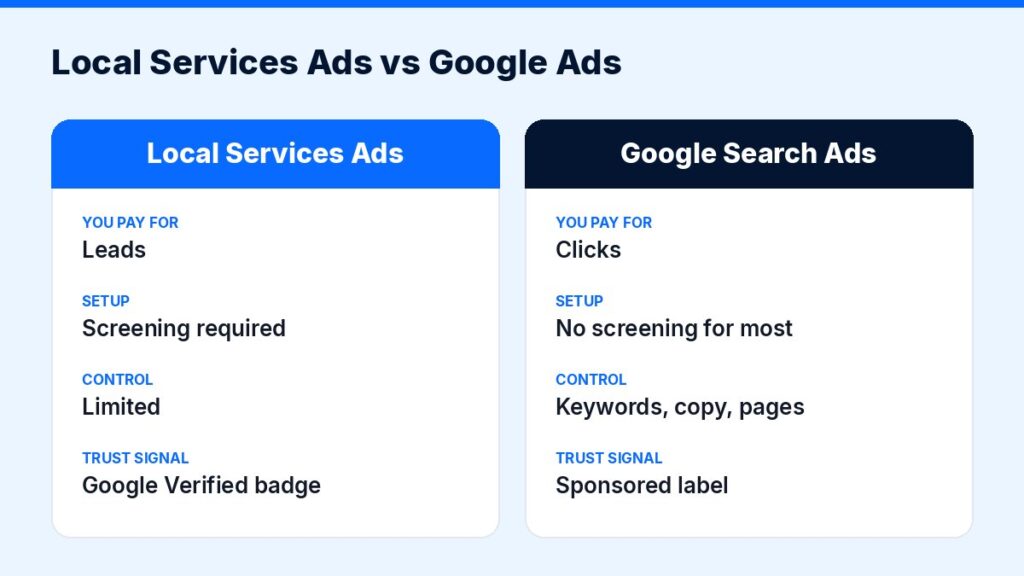
| Local Services Ads | Google Ads (Search) | |
|---|---|---|
| You pay for | Leads | Clicks |
| Setup | Screening and verification required | No screening for most businesses |
| Control | Limited: services, areas, hours, budget, bid | High: keywords, ad copy, landing pages, schedule |
| Landing page | Your LSA profile; no website needed | Your website or landing page |
| Trust signal | Google Verified badge | Standard “Sponsored” label |
| Best for | Eligible local service businesses that answer fast | Any business, any service, more targeting options |
Many businesses run both: LSAs to capture high-intent local calls, and Search campaigns for services, keywords or areas LSAs do not cover. Read our guide to Google Ads budgets for small businesses to plan spend across both.
Pros of Local Services Ads
- Pay per lead, not per click. You are not paying for people who look and leave.
- Top-of-page visibility for eligible searches.
- Trust badge that can help first-time customers choose you.
- No website required to start, although a good site still helps customers who research further.
- Lead credits for poor-quality or invalid leads in eligible categories.
Cons of Local Services Ads
- Limited control. You cannot choose keywords or write ad copy the way you can in Google Ads.
- Screening takes time and may require documents, insurance and background checks.
- Lead quality varies. Some calls will be wrong-service, wrong-area or price shoppers, and not all poor leads are credited.
- Missed calls cost you. Unanswered calls during business hours can still count as leads, and they hurt your ranking.
- Reviews matter a lot. New businesses with few reviews can struggle to compete.
Are Google Local Services Ads Worth It for Your Business?
LSAs are usually worth testing if:
- Your category is eligible in your area.
- Someone answers the phone reliably during the hours your ads run (or you turn on messages and bookings and respond fast).
- You already have, or can quickly build, a solid base of genuine reviews.
- Your average job value comfortably covers a lead cost plus your close rate. Example: if a lead costs $X and you close 1 in 3, a customer costs 3 × $X in ad spend. Compare that to your profit per job.
They may not be worth it yet if you cannot answer calls, your reviews are thin, or your jobs are very low value.
How to Get Better Results From LSAs
- Answer every call during ad hours, or set ad hours to when you can answer.
- Turn on message leads (and booking where available) for after-hours contacts.
- Build reviews steadily. See our guide on how to get more Google reviews.
- Complete your profile with a clear bio, accurate services and good photos.
- Mark lead outcomes in your dashboard and use the feedback options for poor leads.
- Review your leads weekly and remove services or areas that bring poor-fit customers.
- Follow up fast. Automated text replies and lead routing help; our AI automation solutions can set that up.
Get Help Setting Up or Fixing LSAs
Our Google Ads and PPC management service covers Local Services Ads setup, verification support, budget and bid management, and lead review, alongside Search campaigns and local SEO.
Get Your Free Marketing Audit
Not sure where your next customers should come from? ScaleMyClick’s free marketing audit looks at your SEO, ads, website conversion and automation and points out 3 specific opportunities that could be limiting your growth. No pressure, no long contract talk, just a clear next step.
Related guides
- How to Generate Leads for a Small Business: 15 Proven Ways
- How to Get Roofing Leads Without Door Knocking
- SEO vs Google Ads: Which Should a Small Business Do First?
FAQ: Google Local Services Ads
How much do Google Local Services Ads cost?
You pay per valid lead, and lead prices vary by location, job type, lead type and bidding mode. You control spend with a weekly budget, and Google says you will not spend more than your monthly max.
Do I pay for spam calls on Local Services Ads?
Google says it filters some invalid activity automatically and can credit low-quality leads, and you can give feedback on leads. Credits are not available for every category.
What is the difference between Local Services Ads and Google Ads?
Local Services Ads charge per lead, require screening and show a verification badge. Google Ads Search campaigns charge per click and give you full control over keywords, ad copy and landing pages.
How do I rank higher in Local Services Ads?
Google lists your bid, your responsiveness, relevance to the search and profile quality, including rating, number of reviews, response time and photos, as ranking factors.
Do I need a website for Local Services Ads?
No, customers contact you from your LSA profile. A good website still helps people who want to research you before calling.