
A sales funnel for small business owners is the path a stranger takes to become a paying customer: they discover you, get interested, compare options, and buy. You create one by picking a single offer, building a landing page with a lead magnet or booking form, and following up automatically by email or text until the lead is ready to buy. You can build a simple version for free, and this guide shows you how, step by step.
What is a sales funnel?
A sales funnel is a model of the buyer’s journey from first contact to purchase. It is called a funnel because many people enter at the top and fewer move through each stage. Your job is to help the right people move to the next step and to stop wasting money on the wrong ones.
For a small business, a funnel is usually not complicated. A roofer’s funnel might be: Google search, service page, free inspection form, a text within minutes, an on-site inspection, a quote, and a follow-up until the job is signed.
The 5 stages of a sales funnel
Different marketers use different labels, but most funnels have five stages:
- Awareness: People discover you through search, social media, ads, or referrals.
- Interest: They visit your website, read a post, or watch a video.
- Consideration: They compare options, download a guide, or ask a question.
- Decision (conversion): They book a call, request a quote, or buy.
- Retention and referral: They come back, buy again, and tell others.
Each stage needs different content. Awareness content answers broad questions. Consideration content compares options and shows proof. Decision content removes risk with clear pricing, clear terms, and an easy next step.
How to create a sales funnel for a small business (step by step)
Step 1: Define your ideal customer and one offer
Write down who you want (industry, location, budget, problem) and the single offer you will lead with. Funnels fail when they try to sell everything to everyone. Start with your most profitable or most requested service.
Step 2: Choose your traffic source
Pick one or two channels where your buyers already are: Google search, Google Business Profile, Facebook and Instagram, LinkedIn, or referrals. Our guide to Google SEO in 2026 covers organic search, and our Google Ads management service covers paid search.
Step 3: Create a lead magnet or entry offer
Give people a reason to raise their hand: a free estimate, a checklist, a short guide, a quiz, or a discounted first visit. The entry offer should be closely related to what you sell.
Step 4: Build a landing page
Your landing page has one job: get the visitor to take the next step. Use a clear headline that matches the ad or post, three to five benefit bullets, social proof you can verify, and a short form or booking calendar. Remove the main navigation so visitors are not distracted.
Step 5: Set up instant follow-up
When someone fills the form, they should get an immediate confirmation by email or text and, for service businesses, a quick personal response. Then add a short sequence over the next one to two weeks that answers common questions, shares proof, and invites them to book.
Step 6: Make the sale easy
Offer a simple way to buy or book: online checkout, a calendar link, or a clear quote with a deadline. Remove steps wherever you can.
Step 7: Follow up after the sale
Ask for a review, send a thank-you, and set reminders for repeat services. Happy customers are the cheapest source of new leads through referrals.
Step 8: Measure and improve
Track how many people move from each stage to the next. If many people visit the landing page but few fill the form, work on the offer and the page. If many leads come in but few buy, work on follow-up and sales.
How do I create a sales funnel for free?
You can build a basic funnel without paying for software:
- Landing page: Use a free plan of a funnel builder or website builder.
- Lead magnet: Create a PDF checklist in a free design tool.
- Email follow-up: Use the free tier of an email tool to send a welcome sequence.
- Booking: Use a free scheduling tool for calls.
- Traffic: Use free channels like your Google Business Profile, social media, and referrals.
The limitation of free tools is usually contacts, automations, or branding. Once the funnel works, upgrading is easier to justify.
Sales funnel software for small business
Here is how two all-in-one tools compare for small business funnels.
| Feature | Systeme.io | HighLevel |
|---|---|---|
| Best for | Solo owners, coaches, course and info-product sellers | Local service businesses and agencies |
| Free option | Free plan | 14-day free trial |
| Funnels and landing pages | Yes | Yes |
| Email marketing | Yes | Yes |
| Two-way SMS and calls | Not a core feature | Yes (usage-based charges) |
| CRM pipelines | Yes | Yes |
| Calendars and booking | Yes | Yes |
Systeme.io
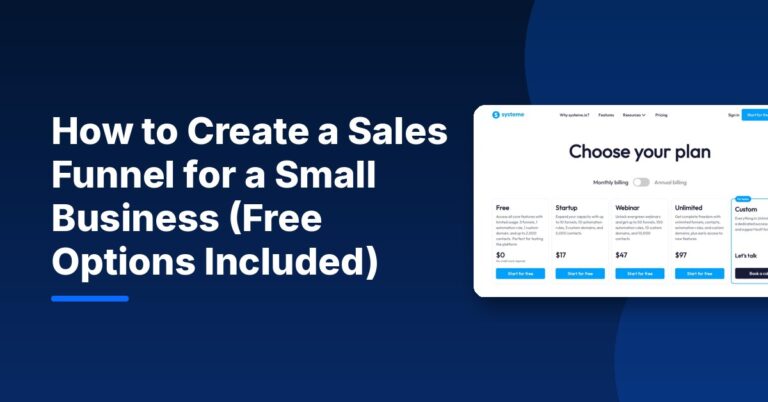
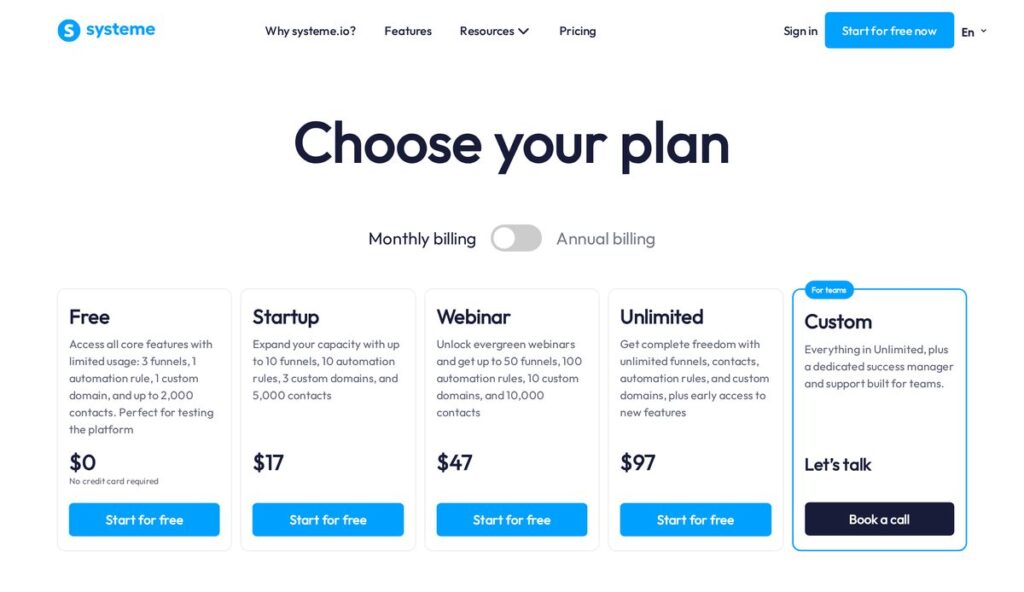
Systeme.io combines funnels, email marketing, automation rules, courses, and a booking calendar in one account. As of November 2026, the systeme.io pricing page shows a Free plan at $0 (no credit card required) with 3 funnels, 1 automation rule, 1 custom domain, and up to 2,000 contacts. Paid plans on monthly billing are Startup at $17, Webinar at $47, and Unlimited at $97 per month. Prices change, so check the official pricing page. It is a good fit if you sell digital products, coaching, or simple services and want to start for free. Read our full Systeme.io review.
Affiliate link — we may earn a commission.
HighLevel
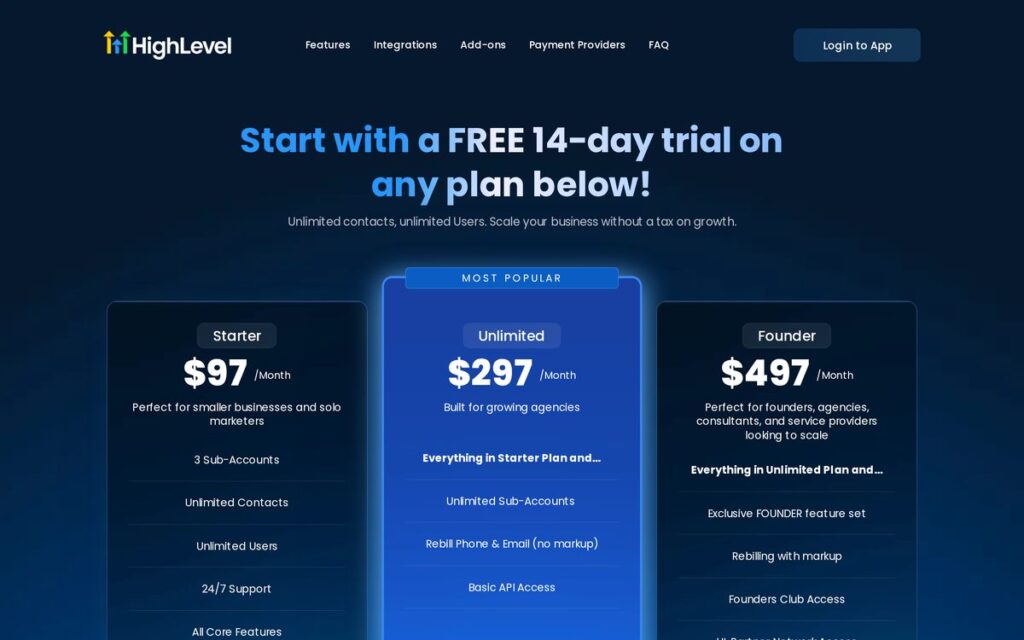
HighLevel (often searched as GoHighLevel) is built around a CRM with pipelines, forms, calendars, two-way texting, email, and workflow automation, which suits service businesses that need fast follow-up by text and phone. As of November 2026, HighLevel’s pricing page lists a free 14-day trial and three plans: Starter at $97/month, Unlimited at $297/month, and Founder at $497/month. Usage-based charges (for example texts, calls, email, and some AI features) are billed on top, and prices change, so check the official pricing page before you sign up. See our HighLevel review for more.
Affiliate link — we may earn a commission.
Comparing more options? Our roundup of the best digital marketing tools for small businesses covers other categories.
Sales funnel examples for small businesses
- Local service (HVAC, roofing, plumbing): Google search → service page → free inspection form → instant text → booked visit → quote → follow-up → review request.
- Coach or consultant: Social post → free quiz or guide → email sequence → discovery call → proposal.
- Online course: Short video → free mini-course → email sequence → course checkout → upsell.
- Restaurant or retail: Social ad → coupon signup → SMS or email offer → visit → loyalty program.
Common sales funnel mistakes
- Sending ad traffic to your homepage instead of a focused landing page.
- Asking for too much information in the first form.
- Following up once and giving up.
- Not tracking which stage loses the most people.
- Building a complex funnel before a simple one works.
Related guides
- 21 Lead Magnet Ideas That Work for Small Businesses
- How to Generate Leads for a Small Business: 15 Proven Ways
- Landing Page Best Practices for 2026: 14 Rules That Lift Conversions
Sales funnel for small business FAQ
What are the 5 stages of a sales funnel?
Most models use awareness, interest, consideration, decision, and retention (or loyalty and referral). Some use fewer stages, but the idea is the same: guide people from discovery to purchase and beyond.
How can I create my own sales funnel?
Choose one offer, pick a traffic source, create a lead magnet or entry offer, build a landing page with a short form, set up automatic follow-up, and track conversion at each step.
How do I create a sales funnel for free?
Use a free funnel builder or website builder plan for the landing page, a free email tool for follow-up, a free scheduling tool for bookings, and free traffic sources like your Google Business Profile and social media.
What is the best sales funnel software for a small business?
It depends on how you sell. Info-product sellers and coaches often prefer tools like Systeme.io, while service businesses that rely on calls and texts often prefer a CRM-first tool like HighLevel.
Want a funnel built for your business?
We design landing pages and follow-up systems that turn clicks into booked calls. Get a free marketing audit, or learn about our AI automation solutions.