
Customers now ask AI tools questions they used to type into Google: “best HVAC company near me with weekend service,” “is this accountant good for small businesses,” “what should a new website cost.” That shift created a new buzzword, GEO, and a lot of confusion. This guide explains GEO vs SEO in plain English, what Google itself says about it, and what a small business should actually do.
What Is GEO (Generative Engine Optimization)?

GEO stands for generative engine optimization: making your content more likely to be used, quoted or linked in answers produced by AI systems such as Google’s AI Overviews and AI Mode, ChatGPT, Gemini, Perplexity and Copilot.
The term was popularized by a research paper, GEO: Generative Engine Optimization, by Pranjal Aggarwal and co-authors, accepted to the KDD 2024 conference. In their tests, the authors report that GEO methods could boost visibility by up to 40% in generative engine responses, and that what works varies by topic area. It is a research result on a benchmark, not a promise for any single website, but it shows that how content is written affects whether AI systems use it.
You will also see AEO (answer engine optimization) and AI SEO. They describe roughly the same goal: being the source an AI answer relies on.
What Is SEO?
SEO (search engine optimization) is the work of helping your pages rank in search results: making sure search engines can crawl and understand your site, publishing content that answers what people search for, and earning trust signals like links and reviews. The goal is traffic, calls and leads from organic search. If you are new to it, our SEO services page gives an overview of what that work includes.
GEO vs SEO: The Key Differences
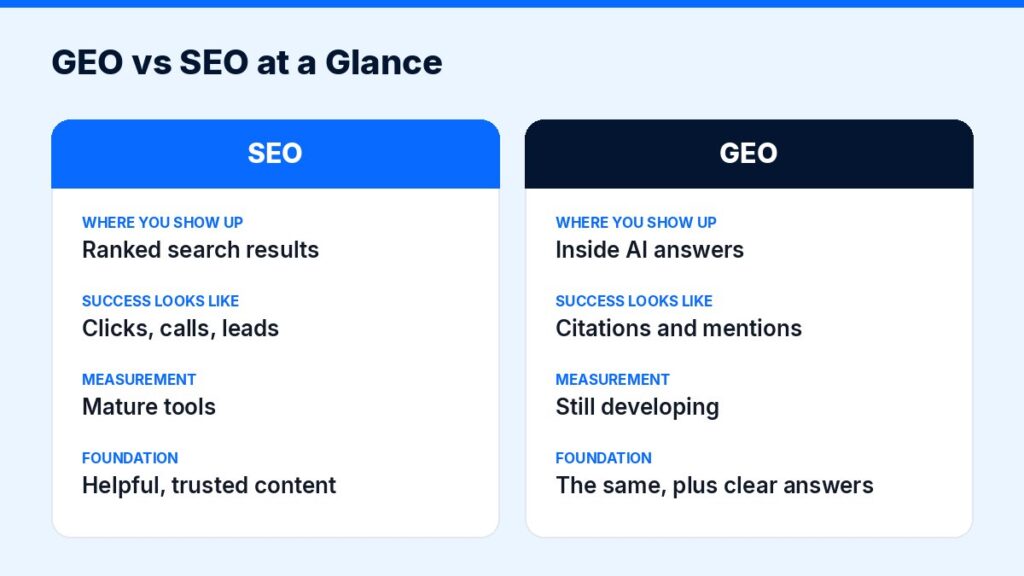
| SEO | GEO | |
|---|---|---|
| Where you show up | Ranked list of results, map pack | Inside an AI-written answer, often with source links |
| What success looks like | Rankings, clicks, calls, leads | Being cited, mentioned or recommended in AI answers |
| How users interact | Scan results and click | Read a summary, then maybe click a source |
| Measurement | Mature (Search Console, analytics, rank tracking) | Still developing |
| Foundation | Crawlable, helpful, trustworthy content | The same, plus clear, quotable answers |
What Google Says About GEO
This is the part most GEO articles leave out. In its guide Optimizing your website for generative AI features on Google Search, Google says:
- SEO best practices continue to be relevant, because its generative AI features are rooted in its core Search ranking and quality systems.
- From Google Search’s perspective, optimizing for generative AI search is optimizing for the search experience, and thus still SEO.
- For Google Search you can ignore tactics like “chunking” content, creating AI text files such as llms.txt, or pursuing inauthentic mentions.
- Structured data is not required for generative AI search and there is no special schema markup for it, although it is still useful for rich results.
- You can monitor performance with the Generative AI performance report in Search Console.
So for Google at least, GEO is not a replacement for SEO. It is SEO done well, with extra attention to being a clear, trustworthy source. Other AI assistants work differently and change often, but they also rely on finding and trusting web content, so the same foundations help there too.
A Practical GEO + SEO Plan for Small Businesses
1. Make sure you can be found and understood
- Your site is indexable and fast, with no important pages blocked.
- Each service has its own page with a clear heading, a short summary and real details (who it is for, what is included, where you work, how to get started).
- Your Google Business Profile is complete and matches your website. See our local SEO checklist.
2. Answer real questions directly
AI answers are built from passages that clearly answer a question. Make your answers easy to lift:
- Put a direct one or two sentence answer right under each question heading, then expand.
- Use the words your customers use. Your sales calls and emails are the best source.
- Add an FAQ section to service pages with honest answers about price ranges, timelines and process.
3. Create “non-commodity” content
Google’s guide encourages content that offers a unique point of view or real experience, rather than restating what is already everywhere. For a small business, that means things only you can write:
- Project stories with photos and specifics.
- Your process explained step by step.
- Honest comparisons and “when not to hire us” advice.
- Local knowledge: permits, weather, regulations, neighborhoods.
4. Build real-world reputation
AI systems and search engines both look for signals that a business is trustworthy:
- Genuine reviews on Google and relevant industry sites (see how to get more Google reviews).
- Mentions in local news, associations and partner websites.
- Consistent business details everywhere.
Google specifically warns that seeking inauthentic mentions is not as helpful as it might seem. Earn mentions; do not buy them.
5. Cite your sources and show expertise
When you use numbers, link to where they came from. Show who wrote the content and why they know the subject. This builds trust with readers and gives AI systems confidence in your page.
6. Measure what you can
- Use Search Console, including the Generative AI performance report Google mentions.
- Ask new leads “how did you hear about us?” and add “AI assistant (ChatGPT, Gemini, etc.)” as an option.
- Periodically ask AI tools the questions your customers ask, and note whether your business appears.
Some SEO platforms now offer AI visibility tracking. Semrush, for example, lists AI Visibility tools on its site. Check current features and pricing before buying, and remember tracking is optional; the content and reputation work above is what moves results.
A Simple Example
Imagine a family-run roofing company. Its old homepage says “Quality roofing since 2005” and lists services in one line. After a GEO-minded rewrite, each service has its own page. The “roof repair” page opens with a two-sentence answer to “how much does roof repair cost in [city],” explains what changes the price, shows recent project photos, lists the areas served, and ends with five honest FAQs. The Google Business Profile is complete and gets new reviews every week. Nothing about this is a trick, yet it gives both a search engine and an AI assistant a clear, trustworthy passage to show or quote.
What Not to Waste Money On
- “Guaranteed ChatGPT rankings.” Nobody controls what AI models say.
- llms.txt as a magic fix. Google says Google Search does not use these files. Creating one is fine for other services, but do not expect it to change your Google visibility.
- Mass-produced AI content. Commodity content that repeats what is already online is exactly what Google says to avoid.
- Fake mentions and reviews. They can harm your reputation and break platform rules.
Do You Need a Separate GEO Agency?
Usually not. A good SEO partner should already be doing the things that matter for AI search: technical health, helpful content, structured answers, reviews and reputation. Google itself suggests reviewing third-party “AEO” or “GEO” advice carefully. If someone sells GEO as completely separate from SEO, ask what exactly they will do differently.
Our SEO services are built for both: classic rankings and visibility in AI answers. If you also want your website rebuilt around clear, answer-first service pages, see our website design and development service.
Get Your Free Marketing Audit
Not sure where your next customers should come from? ScaleMyClick’s free marketing audit looks at your SEO, ads, website conversion and automation and points out 3 specific opportunities that could be limiting your growth. No pressure, no long contract talk, just a clear next step.
Related guides
- Google SEO Guide 2026: How to Rank Higher Now
- Semrush vs Ahrefs: Which SEO Tool Should a Small Business Choose?
- How Much Does SEO Cost for a Small Business in 2026?
FAQ: GEO vs SEO
Is GEO replacing SEO?
No. Google says optimizing for its generative AI features is still SEO, because those features rely on its core ranking and quality systems. GEO is best seen as an extension of good SEO.
What is the difference between GEO and AEO?
They are two names for very similar ideas. Both focus on being used as a source in AI-generated answers. The practical work is largely the same.
Do I need llms.txt for AI search?
Google says Google Search does not use llms.txt or similar files, so you do not need one to appear in Google’s AI features. Some other services may read them; creating one is optional.
How do I know if my business shows up in AI answers?
Use Search Console’s Generative AI performance report for Google, ask new leads how they found you, and regularly test the questions your customers ask in popular AI tools.
Can a small business compete in AI search?
Yes. AI answers often draw on specific, helpful pages and trusted local signals, which a small business can build. Clear service pages, genuine reviews and expert content are within reach for any business.