
Every small business owner with a marketing budget eventually faces the same question: SEO vs Google Ads, which one first? Both put you in front of people searching on Google. One charges you for every click; the other takes time but keeps working. This guide breaks down how each works, what they cost, how fast they deliver, and gives you a simple framework to decide where your first dollar should go.
SEO vs Google Ads: The Basics
SEO (search engine optimization) helps your website and Google Business Profile appear in the free, organic results and the local map pack. You do not pay Google per click. You invest in content, technical improvements, reviews and authority, usually through time or an agency fee.
Google Ads (often called PPC, pay-per-click) lets you bid to appear in the sponsored results for searches you choose. You pay when someone clicks your ad. Results can start as soon as your campaign is approved and running.
Side-by-Side Comparison
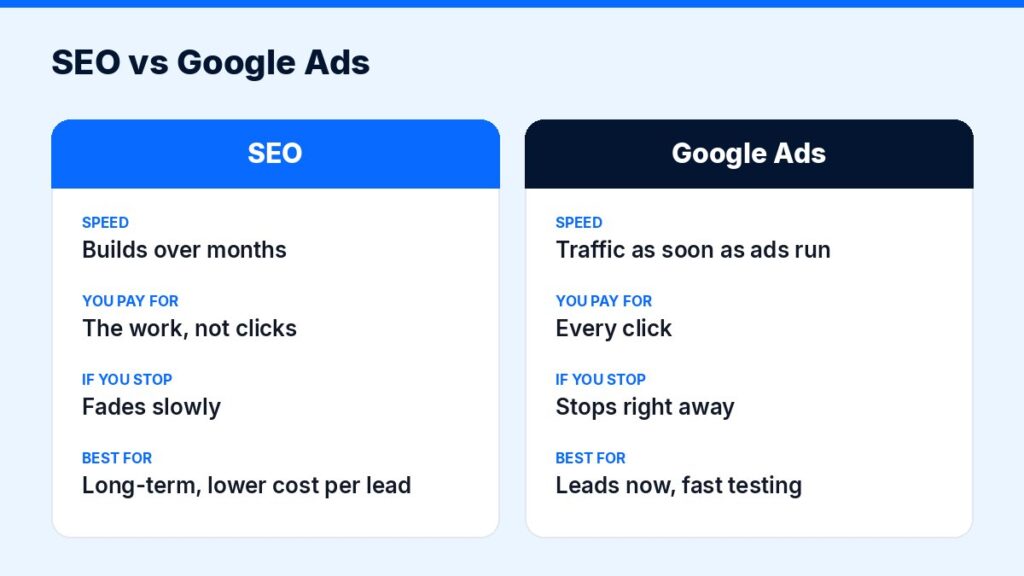
| Factor | SEO | Google Ads |
|---|---|---|
| Speed | Builds over months | Traffic as soon as ads run |
| Cost model | Ongoing effort or agency fee; clicks are free | Pay per click, plus management |
| When you stop paying | Rankings usually fade slowly | Traffic stops right away |
| Control | Limited; Google decides rankings | High: keywords, budget, locations, schedule |
| Testing | Slow to test offers and messages | Fast to test offers, headlines and landing pages |
| Trust | Many searchers trust organic results | Clearly labeled as sponsored |
| Long-term value | Compounds over time | Value stays tied to your spend |
What Each One Costs
Google Ads: You set your own budget, and Google explains how billing works in its help article on average daily budgets. For most campaigns, Google may spend up to 2 times your average daily budget on a given day, but you will not be charged more than 30.4 times your average daily budget in a month. What you pay per click depends on your industry and competition. WordStream’s Google Ads benchmarks for 2026 (based on more than 13,000 campaigns) put the average cost per click at $5.42 and the average cost per lead at $66.69, with large differences between industries.
SEO: You pay for the work, not the clicks. Survey data from Ahrefs suggests local SEO averages about $1,557 per month. See our full breakdown of how much SEO costs for a small business.
When Google Ads Should Come First
Start with Google Ads if:
- You need leads now. A new business, a new location or a slow season needs results this month.
- Your website is new. New sites often need time to build enough authority to rank for competitive terms.
- You want to test demand. Ads tell you quickly which services, offers and messages get calls.
- Your service is urgent. People searching “emergency plumber” or “locksmith near me” often click the first result they see, including ads.
- You have strong margins. If one new customer is worth a lot, a higher cost per lead can still be very profitable.
Our Google Ads and PPC management service is built for exactly these situations.
When SEO Should Come First
Start with SEO if:
- You can wait a few months. You have other lead sources and want to lower your cost per lead over time.
- Your customers research before buying. People compare options for weeks before choosing a lawyer, a contractor for a big project or a B2B service.
- Clicks in your industry are very expensive. When paid clicks cost a lot, every organic visitor is worth more.
- Your Google Business Profile is weak. For local businesses, fixing the profile and reviews is often the cheapest win available.
- You want an asset you own. Content and rankings keep working even if you pause spending.
Our SEO services focus on these long-term wins.
The Best Answer for Most Small Businesses: Both, in the Right Order

For many small businesses the strongest plan is a phased one:
- Fix the foundation. Make sure your website loads fast, works on mobile and makes it easy to call or book. Ads and SEO both fail if the website does not convert. See our website design and development service if yours needs work.
- Launch a focused Google Ads campaign. Target your most profitable services and locations to bring leads in now and learn which keywords convert.
- Start SEO at the same time. Use the keyword data from your ads to choose which pages to build and improve.
- Shift budget gradually. As organic rankings and map pack visibility grow, you can reduce ad spend on keywords where you rank well and focus ads on the most competitive or seasonal searches.
A Simple Decision Framework
Answer these four questions:
- Do I need leads in the next 30 days? If yes, start with Google Ads.
- Is my website ready to convert visitors? If no, fix the website first.
- Can I wait several months for a return? If yes, invest in SEO.
- Is my monthly marketing budget small? If yes, consider starting with free local SEO work (Google Business Profile and reviews) plus a tightly focused ads campaign on your top service.
A Quick Example
Picture a new dental practice in a growing suburb. It has a fresh website, few reviews and an empty appointment book. Waiting months for SEO alone would leave chairs empty, so it starts a focused Google Ads campaign for high-value searches like “emergency dentist” and “dental implants” in its area. At the same time it builds out its Google Business Profile, asks every patient for a review, and creates a page for each treatment. The ads keep the calendar moving in the first months, and the search terms report shows which treatments people actually look for. Those insights decide which SEO pages get written first. Over time, as organic visibility grows, the practice can shift more budget toward the services where ads perform best.
Common Mistakes With Each Channel
Google Ads mistakes:
- Sending ad traffic to the homepage instead of a page for the specific service.
- Broad keywords without negative keywords, paying for irrelevant searches.
- No conversion tracking, so you cannot see which ads bring leads.
- Turning ads on and off too often, before the account has learned.
If your ads already run but leads are thin, read Google Ads not converting? 11 fixes.
SEO mistakes:
- Expecting results in weeks and quitting too early.
- Targeting broad keywords you cannot realistically rank for.
- Ignoring Google Business Profile and reviews.
- Buying cheap links or content that can do more harm than good.
What About AI Search?
AI Overviews and AI chat assistants now answer many questions directly. Google says its AI features rely on its core ranking systems, so solid SEO helps you appear there too. Ads remain a separate, paid placement. Learn more in our guide to GEO vs SEO.
Get a Clear Recommendation
The right mix depends on your market, margins and website. Our free audit looks at your current visibility and ad opportunities and tells you where to start.
Get Your Free Marketing Audit
Not sure where your next customers should come from? ScaleMyClick’s free marketing audit looks at your SEO, ads, website conversion and automation and points out 3 specific opportunities that could be limiting your growth. No pressure, no long contract talk, just a clear next step.
Related guides
- How Much Do Digital Marketing Agencies Charge Per Month?
- Marketing Budget for a Small Business: How to Set One
- Google Ads Budget for Small Business: How Much to Spend
FAQ: SEO vs Google Ads
Is SEO or Google Ads better for a small business?
Neither is better in every case. Google Ads is faster and easier to control; SEO is slower but builds a lasting asset with no cost per click. Many small businesses use both, starting with ads for immediate leads while SEO builds.
How long does SEO take compared to Google Ads?
Google Ads can bring traffic as soon as campaigns run. SEO usually takes months of consistent work to bring meaningful results, although Google Business Profile improvements can help sooner.
How much should I spend on Google Ads as a small business?
It depends on your cost per click, how many leads you need and what a customer is worth. Our guide to Google Ads budgets for small businesses shows how to calculate it.
Do Google Ads help SEO rankings?
Paying for ads does not directly improve your organic rankings. But ads give you keyword and conversion data that can guide your SEO strategy.
Can I stop Google Ads once SEO works?
You can reduce ad spend for keywords where you rank well, but many businesses keep some ads running for competitive, seasonal or high-value searches.