


“Post every day” is the advice you hear everywhere, and it is the advice most small businesses cannot follow. So how often should a small business post on social media? The honest answer is: as often as you can keep up with good content, on the platforms where your customers actually are. This guide gives you research-backed starting points for each platform, a realistic small-business version, and a simple weekly schedule you can copy.
The Short Answer
Buffer’s 2026 posting frequency guide recommends these starting points:
| Platform | Buffer’s recommended frequency | Realistic small-business minimum |
|---|---|---|
| 1–2 posts per day | 3 posts per week | |
| 3–5 posts per week | 3 posts per week | |
| TikTok | 2–5 posts per week | 2 posts per week |
| 2–5 posts per week | 2 posts per week | |
| YouTube | 1 video per week | 1–2 videos per month |
| YouTube Shorts | 1–3 per week | 1–2 per week |
| X (Twitter) | 3–4 posts per day | Only if your audience is there |
| 15–25 pins per day | Only for visual, product or DIY businesses |
The “realistic minimum” column is our suggestion for a business owner with limited time, not a research figure. Buffer itself makes the same point: small businesses rarely have the time and budget to hit the ideal frequency, so the right number is the number you can stick to.
Why Consistency Beats Volume
Buffer reports that its analysis of more than 100,000 Buffer users found regular posting leads to 5x more engagement. Hootsuite’s posting schedule guide says the same in different words: posting frequency varies by platform, but consistency matters more than volume.
In practice that means three posts every week for a year beats a burst of daily posts for two weeks followed by silence. Algorithms and audiences both reward reliable accounts.
Does Posting More Help?
Yes, up to a point. In Buffer’s Instagram data, compared with posting 1–2 times per week:
- Posting 3–5 times per week was linked with about 12% more reach per post.
- Posting 6–9 times per week was linked with about 18% more reach per post.
- Posting 10+ times per week was linked with about 24% more reach per post.
Notice the diminishing returns. The biggest jump is going from once or twice a week to three to five times. After that, each extra post adds less, while the work keeps growing. For most small businesses, three to five good posts a week on Instagram is the sweet spot.
Platform-by-Platform Guide for Small Businesses
Facebook still matters for local businesses, community groups and older audiences. Buffer cites a HubSpot study suggesting one to two posts a day for Pages. If that is too much, aim for three solid posts a week: one helpful tip, one piece of proof (a review, a before-and-after), and one offer or event.
Great for visual businesses: restaurants, salons, fitness, home improvement, retail. Mix Reels (for reach), carousels (for saving and sharing) and Stories (for staying top of mind with existing followers).
TikTok
Strong for reaching new people quickly if you are willing to show your face, your team or your process. Two to five short videos a week is Buffer’s suggested range. Buffer notes that posting more gives you more chances at a breakout video rather than making every video perform better.
Essential for B2B services: accountants, consultants, agencies, IT, commercial contractors. Two to five posts a week from the owner’s personal profile often outperform a company page. Share opinions, lessons and client results you are allowed to share.
YouTube
YouTube is a search engine, so videos keep bringing views for years. One video a week is Buffer’s recommendation; one or two a month is fine for a small team if each one answers a question your customers search for.
How to Choose Your Platforms
You do not need to be everywhere. Pick one or two primary platforms based on:
- Where your customers spend time. Ask them. Check where your competitors get engagement.
- What content you can create. Photos and short videos favor Instagram and TikTok. Written expertise favors LinkedIn and Facebook.
- Your business type. Local and B2C businesses usually start with Facebook and Instagram. B2B usually starts with LinkedIn.
Do one or two platforms well before adding a third.
A Simple Weekly Schedule You Can Copy
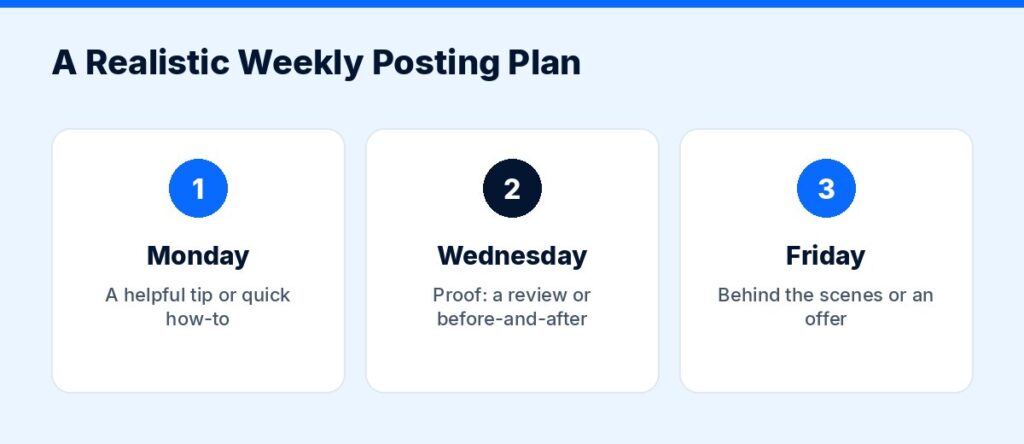
Here is a realistic plan for a small business focusing on Instagram and Facebook:
| Day | Post | Format |
|---|---|---|
| Monday | Helpful tip or how-to from your expertise | Carousel or short video |
| Wednesday | Proof: customer review, project photo or before-and-after | Photo or Reel |
| Friday | Behind the scenes, team, or offer of the week | Reel or Story |
| Daily (optional) | Quick Stories: today’s work, a question, a poll | Stories |
Batch-create the week’s posts in one sitting, schedule them, and spend a few minutes each day replying to comments and messages.
Work Smarter: Create Once, Publish Everywhere
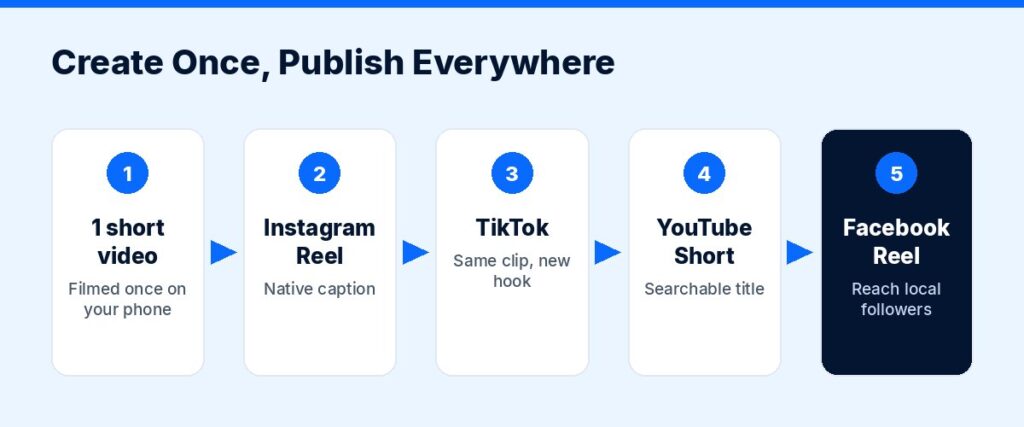
The easiest way to post more without working more is to repurpose. One short video can become a Reel, a TikTok, a YouTube Short and a Facebook Reel. One blog post can become a carousel, a LinkedIn post and three Stories.
Tools can automate this. Repurpose.io, for example, says on its website that it lets you post on one platform and automatically repurpose that content to others, including videos, Stories and audio. It offers a free trial; check current plans and limits on its site.
Affiliate link — we may earn a commission.
What to Post When You Run Out of Ideas
- Answers to the questions customers ask you every week.
- Before-and-after photos or a short project walkthrough.
- A customer review turned into a graphic (with their permission).
- A “day in the life” of your team.
- Common mistakes people make, and how to avoid them.
- Seasonal tips related to your service.
- Your opinion on a trend in your industry.
Common Posting Mistakes to Avoid
- Only posting promotions. If every post says “call now” or “20% off,” people stop paying attention. Lead with value and proof; keep offers to a small share of your posts.
- Posting and disappearing. Comments and messages are where conversations turn into customers. Reply the same day when you can.
- Copying big brands’ frequency. A national brand with a content team is not your benchmark. Your competitors in your town are.
- Ignoring video. Short video is a strong format on most major platforms. A simple phone video of your work is enough to start.
- No call to action. Tell people what to do next: book, call, message or visit your website.
How to Know If Your Posting Frequency Is Working
Check your analytics monthly and look at:
- Reach and impressions per post, not just follower count.
- Saves, shares and comments, which signal useful content.
- Profile visits, website clicks and messages.
- Leads and sales you can trace to social (ask new customers how they found you).
If engagement drops when you post more, quality may be slipping. If it rises, try adding one more post per week and measure again.
Need Help Staying Consistent?
Consistency is the hardest part of social media for busy owners. Our social media marketing service plans, creates and schedules content for you, and our AI automation solutions can handle the repetitive parts like scheduling and lead follow-up from social messages.
Get Your Free Marketing Audit
Not sure where your next customers should come from? ScaleMyClick’s free marketing audit looks at your SEO, ads, website conversion and automation and points out 3 specific opportunities that could be limiting your growth. No pressure, no long contract talk, just a clear next step.
Related guides
- How to Repurpose Content Across Platforms (Without Extra Hours)
- How to Get Leads on LinkedIn for Free (Step by Step)
- Facebook Ads for Small Business: A Beginner’s Guide for 2026
- Marketing Tools & Resources (our recommended tools)
FAQ: Social Media Posting Frequency
How many times a week should a small business post on social media?
A realistic target is three posts per week on your main platform, plus a couple on a second platform. Increase from there if you can keep the quality high.
Is posting every day too much for a small business?
Not if you can keep it up with useful content. But posting daily with weak content can hurt engagement, and burning out leads to long gaps. Consistency matters more than volume.
How often should a business post on Instagram?
Buffer recommends three to five feed posts per week, which its data shows is where most of the reach gain comes from. Stories can be more frequent.
What is the best time to post on social media?
It depends on your audience. Start with general research, then check your own analytics to see when your followers are online and adjust.
Should I post the same content on every platform?
Repurposing is smart, but adjust the format and caption for each platform. A LinkedIn post needs different framing than a TikTok, even if the core idea is the same.
This contains an affiliate link.